Plant profile
Persian silk tree
Albizia julibrissin
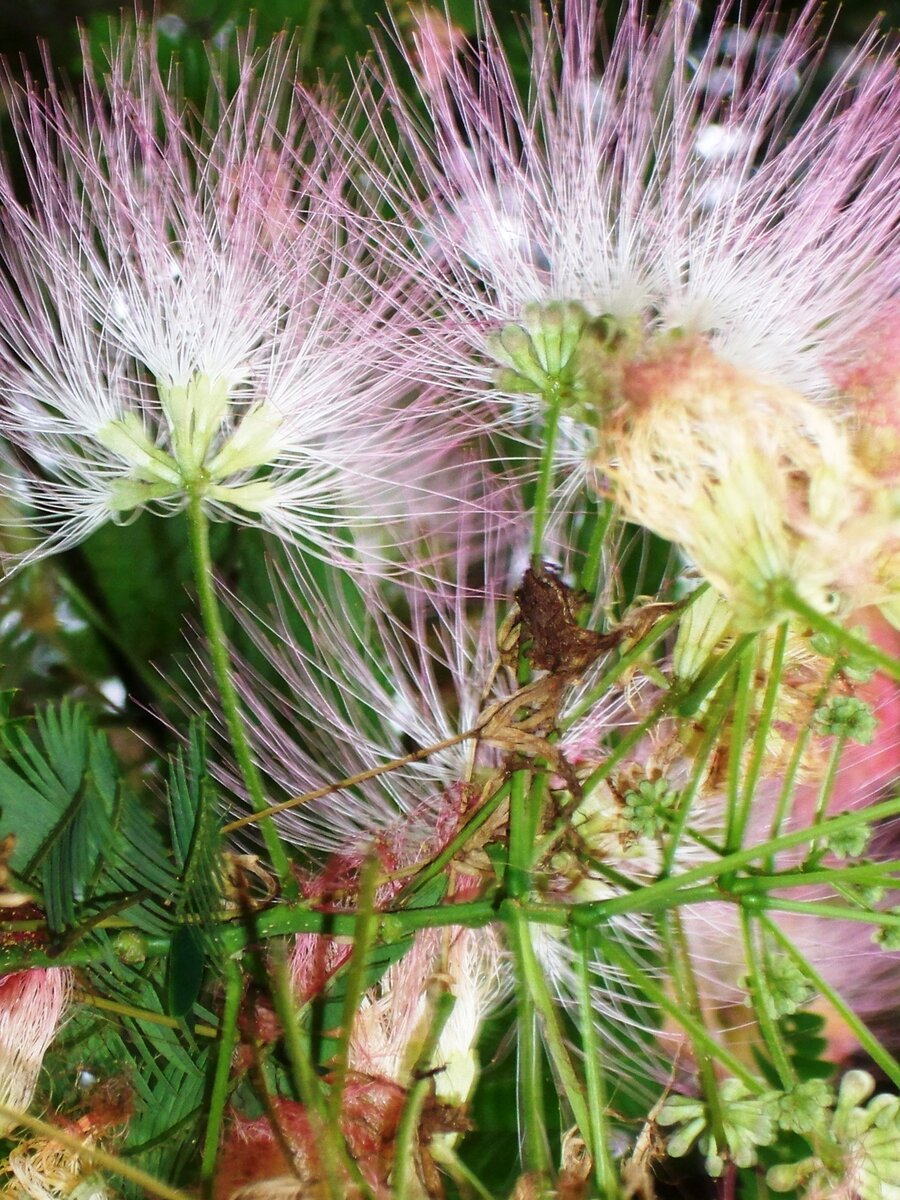
Ornamental tree with a broad, umbrella-shaped canopy, bipinnate leaves that close at night and showy pink inflorescences shaped like silky tufts.
Did you know?
The genus name is dedicated to the Italian noble naturalist Filippo degli Albizzi, who introduced the plant to Europe in the 18th century.
Its bipinnate leaves close at night or during storms (a movement called nyctinasty), hence the English name "silk tree".
It is a nitrogen-fixing legume: like many Fabaceae, it hosts symbiotic bacteria in its roots capable of enriching the soil with nitrogen.
In the garden
Origin Donato da Graziano Mancini e sua madre Luciana
Zone plateau
Quantity 1
Main function OrnamentalPollinator attractionWindbreak
Toxicity Toxic: seeds and pods contain alkaloids, dangerous if ingested in large quantities (humans and animals)
Learn more Wikipedia (opens in a new tab)
Information
Flowering period June–September
Fruiting period September–November (flattened pods, persistent in winter)
Exposure Full sun
Water needs Low–Medium
Tolerated temperature -15°C / +40°C
Soil type Adaptable, well-drained; tolerates drought, poor and brackish soils
Foliage type Deciduous
Flower colour Pink / White-pink (silky tufts)
French Arbre à soie (Albizia)
German Seidenbaum (Schlafbaum)
Spanish Árbol de la seda
Portuguese Acácia-de-constantinopla
Arabic شجرة الحرير (اللبخ)
Ukrainian Альбіція ленкоранська (Шовкова акація)
Scientific classification
Division Magnoliophyta
Class Magnoliopsida
Order Fabales
Family Fabaceae
Genus Albizia