Plant profile
Milkflower cotoneaster
Cotoneaster lacteus
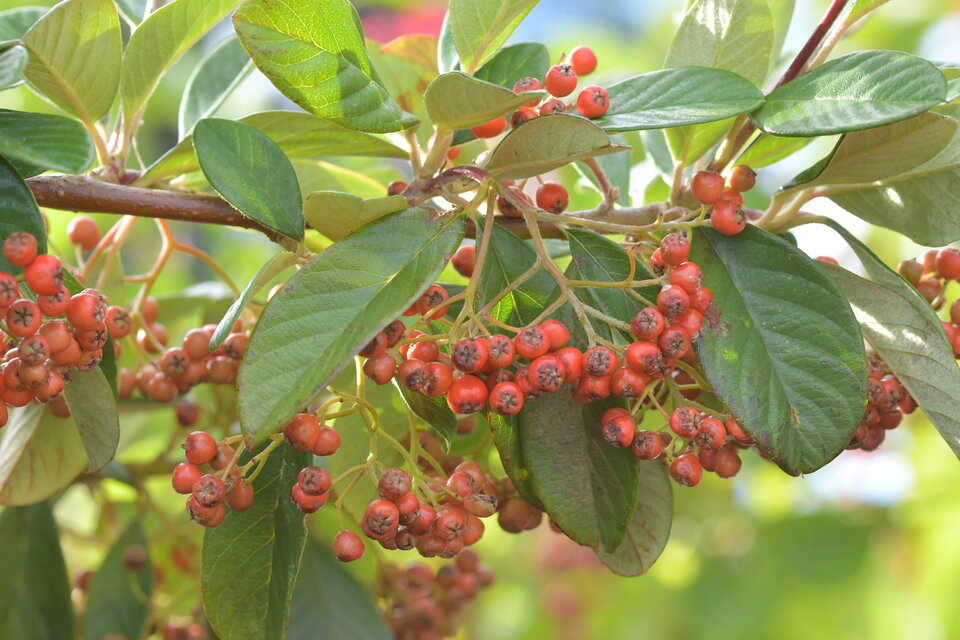
Vigorous evergreen shrub with leathery dark green leaves and a whitish underside, abundant white summer flowering and persistent clusters of red berries in autumn-winter.
Did you know?
The genus name "Cotoneaster" does not derive from "cotton" but from the Latin "cotoneum" (quince), referring to the resemblance of the leaves to those of the quince, and "aster" (similar to).
It has received the prestigious Award of Garden Merit from the British Royal Horticultural Society, a recognition reserved for plants of exceptional ornamental value and ease of cultivation.
Its red berries, persisting on the branches throughout winter, are a vital food source for blackbirds, thrushes and other birds in the coldest months.
In the garden
Origin Donato da Vivai Forestali Regione Campania
Zone well
Quantity 1
Main function OrnamentalScreening / HedgeBiodiversityPollinator attraction
Toxicity Berries mildly toxic if ingested in large quantities (contain cyanogenic glycosides)
Learn more Wikipedia (opens in a new tab)
Information
Flowering period June–July
Fruiting period September–February (persistent red berries, attractive to birds)
Exposure Full sun / Partial shade
Water needs Low–Medium
Tolerated temperature -15°C / +38°C
Soil type Well-drained; adapts to many substrates, even calcareous and poor
Foliage type Evergreen
Flower colour White
French Cotonéaster laiteux
German Lederfrucht-Zwergmispel
Spanish Cotoneáster de hoja coriacea
Portuguese Cotoneáster-lactante
Arabic كوتونياستر جلدي الأوراق
Ukrainian Кизильник молочноквітковий
Scientific classification
Division Magnoliophyta
Class Magnoliopsida
Order Rosales
Family Rosaceae
Genus Cotoneaster